Airbus A320
The Latest Developments and the Global Impact of the 2025 Recall
12/1/202512 min read


Introduction
The Airbus A320, a symbol of innovation and efficiency in commercial aviation, became the center of global attention at the end of 2025 due to a series of unprecedented events. A software failure, triggered by a serious incident involving a JetBlue flight, led to a global recall that affected more than half of the active A320 Family fleet. This article explores in detail the recent events, the operational and financial impacts, the responses from airlines and authorities, as well as discussing the technical implications and the prospects for the future of commercial aviation.
Timeline of Key Events
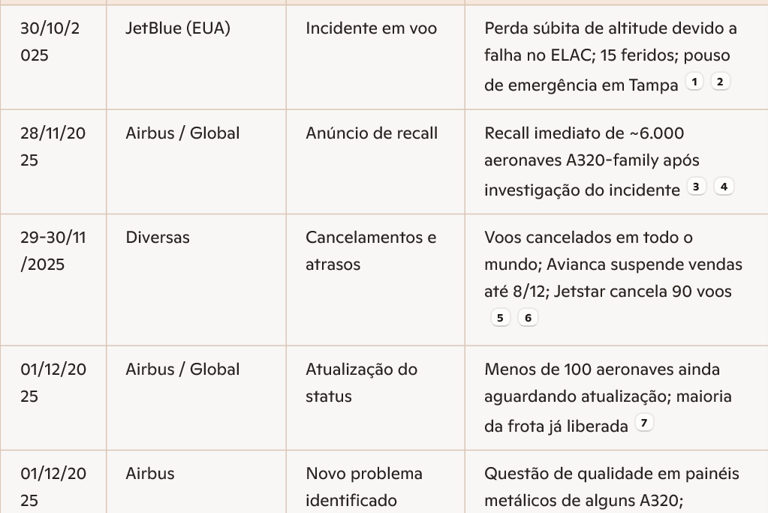
To contextualize the magnitude of these events, we present a summarized timeline of the most relevant facts:
The JetBlue Incident: The Trigger for the Global Recall
The starting point of the crisis was JetBlue flight 1230, operated on October 30, 2025, between Cancún (Mexico) and Newark (USA). During cruise, the A320-200 aircraft suffered a sudden and uncommanded loss of altitude, resulting in injuries to at least 15 passengers and crew. The plane was forced to divert to Tampa, where it performed an emergency landing.
The technical investigation revealed that the problem was related to the ELAC (Elevator and Aileron Computer), one of the critical computers in the A320’s fly-by-wire system. The ELAC is responsible for interpreting pilot and autopilot inputs, controlling the elevators (pitch) and ailerons (roll). In the case of the JetBlue flight, a failure in ELAC 2, caused by data corruption due to intense solar radiation, generated a false pitch-down command, leading to the abrupt descent.
The event was considered extremely serious as it exposed a vulnerability previously thought unlikely: the influence of natural phenomena, such as solar storms, on critical electronic systems of modern aircraft. The swift response of authorities and Airbus prevented more severe consequences, but the episode served as a wake-up call for the entire industry.
The Global Recall: Scope, Motivations, and Immediate Actions
Scope of the Recall
After analyzing the incident, Airbus determined that around 6,000 aircraft of the A320 family (including A318, A319, A320, and A321) were potentially vulnerable to the same type of failure. This represents more than half of the global active fleet, estimated at about 11,300 aircraft.
The recall was one of the largest in the history of commercial aviation, both in number of aircraft and geographic coverage, affecting more than 350 operators across all continents.
Technical Motivations
The problem was traced to a specific version of the ELAC software (ELAC B L104), which, under conditions of intense solar radiation, could suffer bit-flips—spontaneous changes in memory bits—leading to corruption of critical flight control data. Although the hardware complied with specifications, the vulnerability was inherent to the software, requiring a rollback to a previous version (ELAC B L103+) or, in older aircraft, replacement of the computer itself.
Immediate Actions and Regulatory Directives
Airbus issued an Alert Operators Transmission (AOT), instructing all airlines to update the software before the next passenger flight. The European Union Aviation Safety Agency (EASA) quickly turned the recommendation into an Emergency Airworthiness Directive (EAD), making the action mandatory throughout the European Union and influencing global regulators such as the FAA (USA), ANAC (Brazil), DGCA (India), and others.
The EAD allowed up to three ferry flights without passengers to reposition aircraft for maintenance but prohibited any commercial operation until the update was completed.
Global Operational Impact: Cancellations, Delays, and Airline Strategies
North America
In the United States, American Airlines, the world’s largest A320 operator, had about 340 of its 480 aircraft affected. The company managed to update all planes in less than 48 hours, minimizing the impact during the busy Thanksgiving holiday.
Delta, JetBlue, and United were also affected but reported limited disruptions, with fewer than 50 aircraft impacted in each case.
JetBlue, the protagonist of the initial incident, collaborated with investigations and quickly implemented the necessary corrections in its fleet.
Latin America
The most critical case was Avianca, whose fleet is mostly composed of A320 aircraft. More than 70% of its planes were affected, leading to suspension of ticket sales until December 8 and cancellation of dozens of flights.
In Brazil, Latam and Azul announced that their domestic operations would not be impacted, as the aircraft in use in the country were not included in the recall. Only two Latam Colombia flights were canceled, and the company reinforced its commitment to safety and passenger service.
Europe
Airlines such as Lufthansa, Air France, EasyJet, and Wizz Air reported punctual cancellations and delays.
Air France canceled 35 flights (about 5% of its daily operation), while EasyJet and Wizz Air managed to update their fleets overnight, avoiding major disruptions.
Lufthansa, with 156 A320 family aircraft, anticipated minor delays and maintained most scheduled flights. Other airlines, such as British Airways and Turkish Airlines, reported minimal impact.
Asia and Oceania
The region was among the most impacted, especially due to the heavy reliance on the A320 family in markets such as India, China, and Japan.
IndiGo, India’s largest operator, had 160 of its 200 aircraft affected but quickly completed the update.
Air India also reported delays but no significant cancellations.
In Japan, ANA Holdings canceled 95 flights in a single day, affecting 13,500 passengers. Peach Aviation, an ANA affiliate, was also impacted. Japan Airlines, with a mostly Boeing fleet, was not affected.
In Australia, Jetstar canceled 90 flights but managed to update most aircraft in less than 24 hours. Air New Zealand also temporarily grounded its A320s, resuming operations after updates.
Middle East and Africa
Airlines such as Flynas (Saudi Arabia) and Turkish Airlines reported punctual delays and adjustments but quickly returned to normal operations.
Local regulators, such as Kuwait’s aviation authority, confirmed the completion of updates in their fleets.
Situation in Brazil: Latam and Azul
In the Brazilian context, the impact of the recall was minimal. Azul Linhas Aéreas reported that none of its A320 aircraft were included in the recall program announced by Airbus. Latam stated that flights in Brazil would not be affected, with impact limited to two flights of its Colombian affiliate.
Both airlines emphasized that safety is their top priority and that any affected passengers would be contacted directly for rebooking or refunds.
The proactive stance of Brazilian airlines, combined with swift communication with customers and authorities, helped avoid major disruptions in the domestic market, despite the global magnitude of the recall.
Airbus Response: Statements, Measures, and Technical Explanations
Airbus adopted a transparent and collaborative stance from the beginning of the crisis. In an official statement, the company acknowledged that the recommendations would cause operational disruptions for passengers and customers but reiterated that safety is the absolute priority. CEO Guillaume Faury apologized for the logistical challenges and delays, highlighting the commitment of the teams to fix the problem as quickly as possible.
From a technical standpoint, Airbus explained that the vulnerability was related to the susceptibility of ELAC B L104 to intense solar radiation, capable of corrupting critical data for the functioning of flight controls. The solution, in most cases, was a rollback to a previous version of the software, considered stable and already tested in thousands of flight hours. For about 1,000 older aircraft, hardware replacement was required, which demanded more time and resources.
The manufacturer also confirmed, on December 1, a new industrial quality issue involving metallic panels in some A320 jets. The defect, originating from an undisclosed supplier, was quickly identified and contained, with inspections underway and assurance that all newly produced panels comply with requirements. There is no evidence that the problem affected aircraft in service, but the news negatively impacted the company’s stock.
Actions by Regulators and Aviation Authorities
The response from regulators was swift and coordinated. The European Union Aviation Safety Agency (EASA) led the process, issuing an Emergency Airworthiness Directive (EAD) that made the software update mandatory before the next commercial flight. The FAA (U.S. Federal Aviation Administration), ANAC (Brazil), DGCA (India), and other national authorities followed the guidance, ensuring a global and uniform approach to risk mitigation.
The EAD allowed ferry flights without passengers for maintenance but prohibited any commercial operation until the corrections were completed. Regulators also reinforced the need to review software and hardware certification protocols, considering the influence of natural phenomena such as solar radiation on critical systems of modern aircraft.
Operational Impact by Region and Major Airlines
Below is a detailed breakdown of the recall’s impact on operations of major airlines and regions:
American Airlines: 340 aircraft affected; update completed in less than 48 hours; operational impact minimized.
JetBlue: Protagonist of the initial incident; rapid fleet update; collaboration with investigations.
Delta Air Lines: Fewer than 50 aircraft affected; limited impact.
United Airlines: Six aircraft affected; minor disruptions.
Avianca: More than 70% of fleet affected; ticket sales suspended until Dec 8; dozens of flights canceled.
IndiGo (India): 160 of 200 aircraft affected; rapid update; punctual delays.
Air France: 35 flights canceled; about 5% of daily operations.
Lufthansa: Few delays; update completed quickly.
EasyJet and Wizz Air: Overnight update; operations normalized rapidly.
Jetstar (Australia): 90 flights canceled; majority of aircraft updated within 24 hours.
ANA Holdings (Japan): 95 flights canceled in one day; 13,500 passengers affected.
The impact was more severe on airlines with high dependence on the A320 family, especially in short- and medium-haul markets such as India, Latin America, and Asia-Pacific. Conversely, companies with diversified fleets or agile maintenance capabilities managed to minimize disruptions.
Status of Updates: Number of Aircraft Updated and Still Grounded
The operational response of airlines and Airbus was notably swift. Within less than 72 hours after the recall announcement, most of the 6,000 affected aircraft had already received the necessary software update. By December 1, fewer than 100 aircraft were still awaiting updates, mainly due to the need for hardware replacement in older models.
This agility was possible thanks to the simplicity of most corrections (software rollback in about two hours per aircraft) and the joint work between manufacturers, airlines, and regulators. Even so, the episode highlighted the pressure on global maintenance capacity (MRO), already burdened by other recalls and shortages of parts and labor.
Additional Issue: Metallic Panels and Industrial Quality
A few days after the software recall, Airbus confirmed a new industrial quality issue involving metallic panels in some A320 jets. The defect, originating from an undisclosed supplier, was quickly identified and contained. The company began inspections on all potentially affected aircraft, ensuring that only a fraction would require additional corrective actions.
Although there is no evidence that the problem affected aircraft in service, the news raised market concerns and caused Airbus shares to drop. The episode reinforces the importance of strict quality controls in the supply chain and the need for transparency in communication with customers and investors.
Financial and Market Consequences for Airbus
The financial impact of the recall was significant. Estimates point to losses of up to US$ 3.8 billion in two weeks, considering passenger re-accommodation costs, compensations, revenue loss, and extra operational expenses for airlines and Airbus itself.
The company’s shares fell more than 10% after the announcement of the metallic panel issue, in addition to the repercussions of the software recall. Analysts highlight that, although Airbus has not officially revised its delivery target for the year, pressure on the production chain and the need for additional inspections may affect short-term financial performance.
On the other hand, the episode boosted the maintenance, repair, and overhaul (MRO) sector, with a sharp increase in demand for software and hardware update services. Specialized companies reported growth of up to 53% in A320-related service sales in the quarter, and projections indicate expansion of the MRO market to US$ 11.6 billion by 2034, driven by investments in predictive maintenance and regulatory compliance.
History and Context of the A320 Family
Launched in 1984 and in operation since 1988, the A320 family revolutionized commercial aviation by introducing the fly-by-wire concept, where pilot commands are transmitted electronically to control surface actuators. The model became a benchmark in efficiency, comfort, and safety, being widely adopted by both traditional and low-cost airlines worldwide.
In 2025, the A320 family surpassed the Boeing 737 as the most delivered commercial aircraft in history, with more than 12,257 units delivered by September and about 11,300 in global operation. The family’s versatility, composed of the A318, A319, A320, and A321 models (including ceo and neo versions), consolidated its presence in short- and medium-haul routes, becoming a key driver of global air transport growth.
Safety Measures and Procedures for Passengers and Crew
The rapid identification and correction of the vulnerability demonstrate the robustness of commercial aviation safety protocols. Regulators and manufacturers reinforced the importance of strictly following maintenance and software update guidelines, as well as keeping communication channels open with passengers and crew.
For passengers, recommendations include:
Checking flight status and possible changes with the airline.
Staying informed through official channels and flight-tracking apps.
In case of cancellation, seeking re-accommodation or refunds according to company policies.
Trusting the safety procedures adopted by airlines and authorities, which prioritize the integrity of everyone on board.
For crews, additional training on emergency procedures and constant updates on the technical characteristics of flight systems are essential to ensure quick and effective responses in atypical situations.
Reactions of Major Operators and Impact on Routes and Sales
Major global airlines adopted varied strategies to mitigate the recall’s impact:
American Airlines: Quickly updated its fleet, minimizing delays and maintaining passenger confidence.
JetBlue: Collaborated with investigations and prioritized safety, reinforcing its institutional image.
IndiGo and Air India: Completed updates in record time, despite the large number of affected aircraft.
EasyJet and Wizz Air: Performed overnight updates, avoiding mass cancellations.
Lufthansa and Air France: Canceled a few flights but quickly resumed normal operations.
Avianca: Faced the greatest impact in Latin America, suspending sales and re-accommodating passengers.
ANA Holdings and Jetstar: Canceled dozens of flights but managed to update most aircraft within a few days.
The impact on routes and sales was more severe in markets highly dependent on the A320 family, especially short- and medium-haul flights. Airlines such as Avianca, Jetstar, and ANA Holdings had to temporarily suspend sales and cancel flights, affecting thousands of passengers and pressuring revenues during a period of high demand.
Technical Implications: Solar Radiation, Avionics, and Future Mitigation
The JetBlue incident and subsequent recall brought to light a previously underestimated issue: the influence of solar radiation on critical electronic aircraft systems. Events such as solar storms and coronal mass ejections can generate high-energy particles capable of causing bit-flips in microprocessors, corrupting essential data for safe flight system operation.
The vulnerability identified in ELAC B L104 highlights the need to strengthen software and hardware resilience against extreme natural phenomena. Experts advocate revising certification protocols, with more rigorous radiation immunity tests and the adoption of redundancy and real-time error detection techniques.
The crisis also accelerated discussions on the use of artificial intelligence and predictive maintenance for continuous monitoring of electronic system health, reducing the risk of unexpected failures and increasing long-term operational reliability.
Comparisons with Previous Recalls and Incidents
The 2025 A320 recall is often compared to the Boeing 737 MAX crisis, which was globally grounded after two fatal accidents in 2018 and 2019 caused by software failures in the MCAS system. Although the A320 episode did not result in fatalities, the scale of the recall and the speed of the response highlight lessons learned by the industry after the Boeing case.
Airbus, unlike Boeing at the time, adopted a transparent stance, openly communicating with customers, regulators, and the public, and prioritizing safety over immediate commercial considerations. Analysts emphasize that the manufacturer’s reputation was preserved thanks to agility and clarity in crisis management.
Impact on the Supply Chain and Maintenance (MRO)
The need to update thousands of aircraft in just a few days put pressure on the global maintenance, repair, and overhaul (MRO) chain. Workshops and technical teams worked intensively to meet demand, facing challenges such as shortages of parts, labor, and hangar capacity, already strained by other recalls and engine inspections.
The episode highlighted the importance of investing in MRO infrastructure, process automation, and workforce training. Companies in the sector reported significant growth in demand for specialized services, and projections indicate market expansion in the coming years, driven by stricter regulatory requirements and advances in predictive maintenance based on AI and machine learning.
Recommendations for Readers: How to Follow Updates and Reliable Sources
Given the complexity and speed of events, it is essential for passengers, industry professionals, and aviation enthusiasts to seek information from reliable and updated sources. Recommendations include:
Following official statements from airlines and Airbus.
Consulting websites of civil aviation authorities (EASA, FAA, ANAC, DGCA, etc.).
Using flight-tracking apps and real-time notifications.
Following aviation news portals such as AviationSource, AeroTime, FlightAware, and Cirium.
Staying alert to updates on official social media channels of companies and regulators.
Transparency and clear communication are essential to maintain public trust and ensure the safety of all involved.
Conclusion: Lessons and Future Perspectives
The global recall of the Airbus A320 family in 2025 represents a milestone in the history of commercial aviation, not only because of its scale and operational impact but also due to the lessons learned about technological resilience, crisis management, and international collaboration.
The rapid identification of the vulnerability, the coordinated response between manufacturers, airlines, and regulators, and the transparency in communication were fundamental to preventing more serious consequences and restoring normality in record time.
The episode reinforces the need for constant vigilance regarding the robustness of electronic systems in the face of extreme natural phenomena, such as solar radiation, and drives the adoption of advanced maintenance and monitoring technologies.
For passengers and industry professionals, the main message is one of confidence: commercial aviation remains the safest mode of transportation in the world, thanks to its unwavering commitment to safety, its ability to adapt to unprecedented challenges, and its relentless pursuit of innovation and operational excellence.
Summary of Recent Airbus A320 Family Events (November–December 2025):
JetBlue Incident (10/30/2025): Sudden loss of altitude due to ELAC failure caused by intense solar radiation.
Global Recall (11/28/2025): ~6,000 A320 family aircraft affected; mandatory software update before the next flight.
Operational Impact: Cancellations and delays worldwide; Avianca, Jetstar, ANA, and others severely impacted.
Situation in Brazil: Latam and Azul not affected in domestic flights; impact limited to international operations.
Airbus Response: Transparency, agility, and prioritization of safety; new metallic panel quality issue identified and contained.
Regulators: EASA, FAA, ANAC, and others issued emergency directives; exemplary international collaboration.
Financial Consequences: Estimated losses of US$ 3.8 billion; Airbus shares declined; MRO sector boosted.
Lessons: Importance of technological resilience, predictive maintenance, and transparent communication.
Stay tuned for upcoming updates and remain informed: aviation is constantly evolving, and every challenge is an opportunity to make the skies even safer for all.